

Industrial plants have invested heavily in APM and AIM programs. Dashboards are richer. Inspection strategies are tighter. Reliability has improved.
And yet a familiar pattern holds: the plant runs safer on paper, but throughput stays flat, asset life is managed by assumption, and downtime continues to surprise.
CAPEX cycles arrive on schedule rather than on evidence. Throughput improvements flatten earlier than expected. The assumption, once everything else has been optimized, is that the plant has reached a practical ceiling.
That assumption is worth examining — not because those programs have failed, but because they were designed to answer different questions.
What APM and AIM were each designed to do
Asset Performance Management (APM) was built to answer one question: When will something break?
The focus of APM has been to incorporate real-time data and analytics into asset maintenance work processes and systems with much focus on rotating equipment.
As Peter Reynolds of Operational IT Research Group notes in his white paper on APM and Structural Performance Management, for asset-intensive industries, this needs to include structural integrity management systems. APM cannot provide real-time insights and an approach to physics-based structural asset integrity with a deep understanding of structural equipment health.
Asset Integrity Management (AIM) was built to answer a different question: Is this asset safe to operate?
It manages degradation – corrosion, fatigue, cracking – through risk-based inspection (RBI) strategy and engineering assessment. It protects assets and confirms regulatory compliance.
Both programs deliver real value. Neither was designed to answer the question that shapes the performance ceiling: How is this asset actually responding, structurally, to how we are running it right now?
Read more: Why Asset Performance Management Isn’t Delivering the Gains Operators Expect
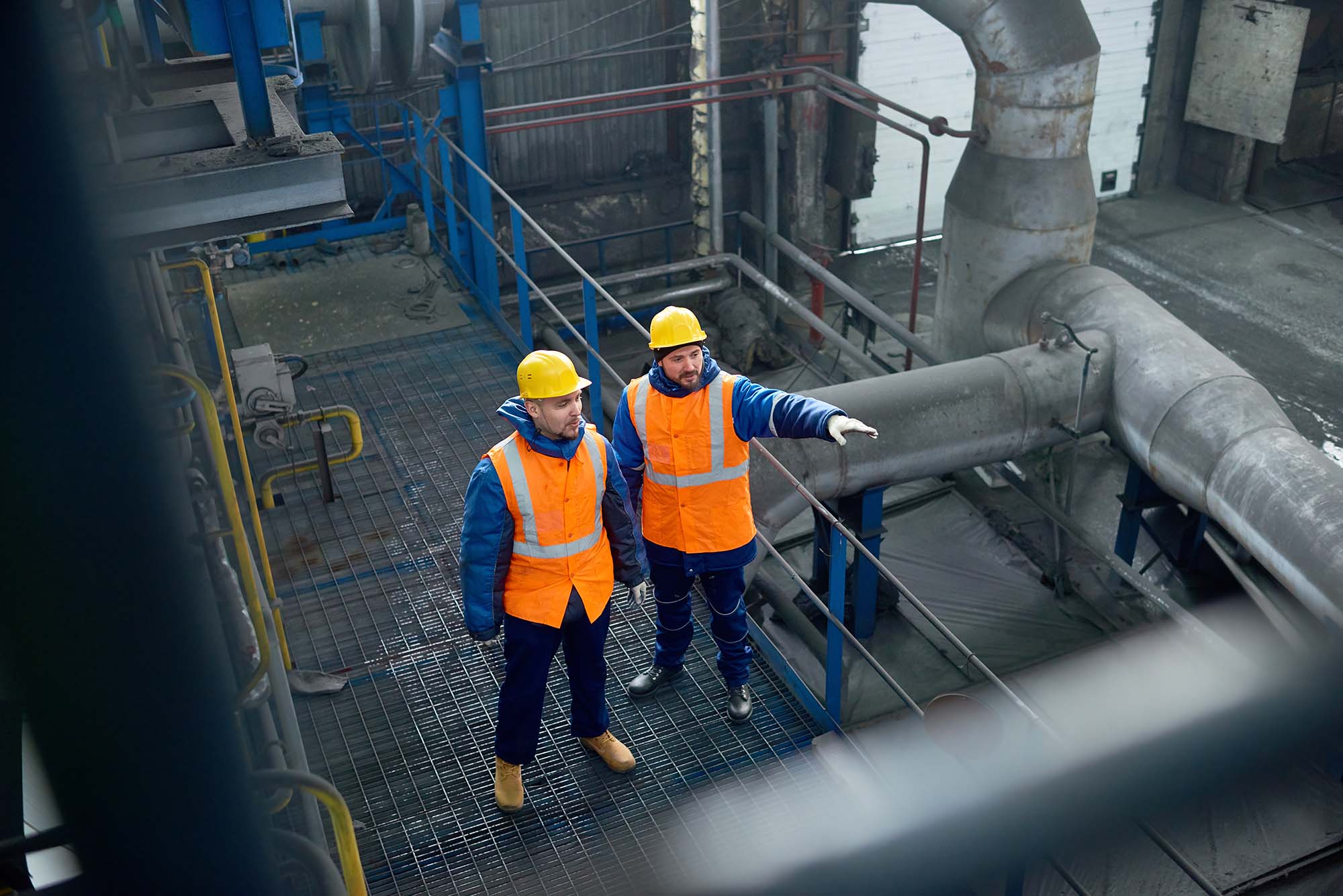
The structural blind spot – What neither program was designed to see
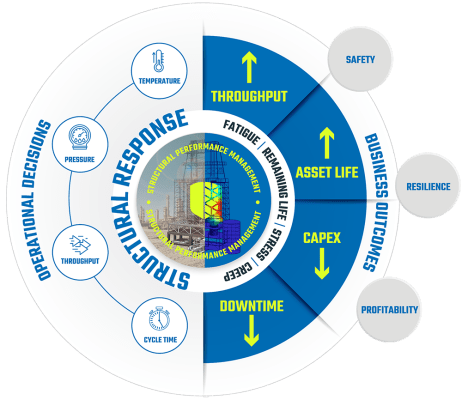
Operators have strong visibility into process conditions: temperature, pressure, flow rates, operating cycles.
What is far harder to see is how those conditions affect the asset itself — the stress accumulating in the steel, fatigue progressing through thousands of cycles, creep building in high-temperature equipment.
These mechanisms develop internally, over time, in the space between inspection intervals.
This is not a data collection problem. It is a visibility problem. And it shapes every operating decision made on that asset — often without those making the decisions realizing it.
The result:
- Safety margins stay conservative because the true structural limits are unknown
- Unplanned downtime occurs when degradation is only visible after the fact
- Operating envelopes set against assumptions rather than observed behavior
- Capital deployed on elapsed time rather than actual asset condition
- Opportunity decisions declined because no one can quickly assess the structural consequences
Explore more: The Limits of Asset Integrity Management in High-Intensity Operations
The constraint is not the asset. It is the lack of visibility into how the asset responds.
What Structural Performance Management does
Structural Performance Management (SPM) connects how assets are operated to how they actually behave — so organizations can improve safety, increase profitability, and strengthen resilience.
In practical terms, SPM:
- Translates stress, fatigue, creep, and deformation into business context in real time
- Shows where operations can safely adapt and where more output is possible
- Identifies where asset life can be protected or extended
- Connects the control room to the boardroom — making structural behavior a management input, not an engineering assumption
SPM is not an extension of APM. It is not an upgrade to integrity management. It is the operating layer that sits above both.
How APM, AIM, and SPM compare

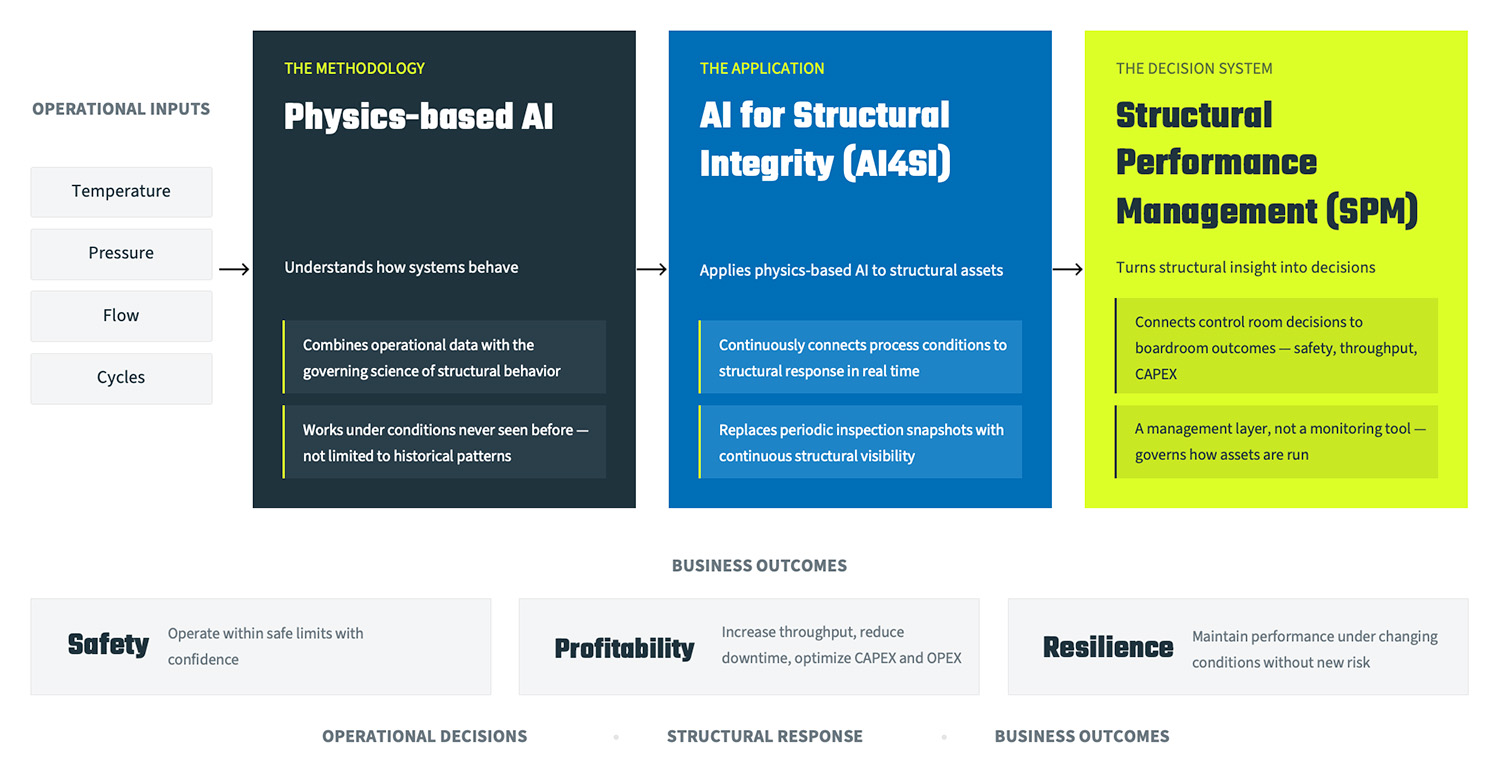
How it works: physics-based AI, AI for Structural Integrity, and SPM
Understanding how SPM works means understanding how three concepts fit together.
Physics-based AI – the methodology: Combines operational data with the governing science of structural behavior. Unlike data-driven AI, it can explain what is happening inside an asset under conditions it has never encountered before – because its understanding comes from physics, not from the frequency of past observations.
AI for Structural Integrity (AI4SI) – the application: Applies physics-based AI continuously to structural assets. Connects process conditions – temperature, pressure, flow, cycles – to structural response: how stress is accumulating, how fatigue is progressing, where the asset stands relative to its true limits.
Structural Performance Management (SPM) – the decision system: Takes the continuous structural insight from AI4SI and makes it actionable across operations, integrity, and leadership. It answers not just what is happening structurally, but what it means for throughput, asset life, CAPEX timing, and risk.
SPM in practice: results from live deployments
SPM is not theoretical. The results below come from live industrial deployments – not pilots.
Key outcomes across deployments:
- Pearl GTL (WEF Lighthouse): +6 years critical asset life, -64% annualized CAPEX, contributions to +9% throughput and 99% reliability
- Shell Bonga FPSO: ~33% OPEX reduction
- Adriatic LNG ORV: +10% throughput, ~€32M CAPEX deferred
- North American refinery: ~25% faster shutdown and startup
In each case, the mechanism is the same: visibility into structural behavior changes what decisions become available – for throughput, for capital, for asset life.
From uncertainty to operating evidence
When structural behavior is invisible, conservatism fills the gap. Engineers manage against assumptions because they have no alternative. That conservatism is rational – but it also means:
- Performance headroom stays hidden
- Capital is deployed earlier than asset condition requires
- Opportunity decisions are made by rule rather than by evidence
When structural behavior is visible, the question changes:
Instead of: Where is output being lost in the process?
Leaders can also ask:
- Which constraints are real?
- Which are inherited from earlier assumptions?
- Which are artifacts of incomplete visibility?
That shift changes how bottlenecks are identified, how run-length decisions are made, how capital is timed, and how risk and performance are discussed across functions.
Key takeaways
- APM and AIM are well-established disciplines. Neither was designed to connect operating decisions to structural response.
- The gap between what those systems see and what structural behavior requires is where performance headroom is lost.
- SPM is the management layer that closes this gap: it makes structural behavior a continuous, real-time input to operational and capital decisions.
- The constraint is not the asset. It is the visibility into how it responds.