
Asset integrity management keeps critical equipment safe, but it wasn't built to answer how much more performance an asset can safely deliver.

Asset integrity management is widely trusted as the foundation of safe and reliable operations. It gives operators confidence that critical equipment can run without failure, within clearly defined boundaries.
And that confidence is well-founded. Asset integrity management has helped the industry prevent catastrophic failures, extend asset life, and sustain operations through increasingly demanding conditions. It remains one of the most mature and rigorous disciplines in industrial management.
But operating reality is evolving. Assets are being pushed harder, run for longer, and exposed to more variable conditions than before. At the same time, performance expectations continue to rise. Operators are under pressure to increase throughput, shorten turnarounds, and respond to changing feedstocks — all while maintaining safety.
As a result, a new question is emerging alongside the traditional one: not just whether assets are safe to operate, but how much more performance they can safely deliver. Asset integrity management was built to answer the first question with precision. The second one points toward a different kind of visibility.
What is asset integrity management designed to do?
At its core, asset integrity management is the structured discipline of ensuring that industrial assets continue to operate safely, reliably, and in compliance throughout their lifecycle – from installation through operation to decommissioning.
It combines inspection strategy, risk-based inspection, maintenance planning, and engineering assessment to manage degradation, maintain structural integrity, and prevent failure in critical equipment.
What value does asset integrity management deliver in oil and gas operations?
At its best, asset integrity management delivers clear and measurable value:
- Prevents catastrophic failures by identifying degradation mechanisms such as corrosion, fatigue, and cracking before they escalate
- Reduces unplanned downtime through proactive inspection and maintenance strategies
- Protects people and the environment by ensuring safe operating conditions at all times
- Extends asset life by maintaining structural soundness over long operating cycles
- Ensures regulatory compliance across increasingly stringent safety and environmental standards
This continued focus is not accidental. Achieving safer operations remains a top strategic priority for industrial firms, with 63% of industrial executives in a Verdantix survey saying they intend to increase spending to support it.
Asset integrity management is designed to answer a single, critical question: can this asset operate safely under defined conditions?
It does this through structured integrity programs built on engineering standards and inspection frameworks. These systems ensure that degradation mechanisms are understood, monitored, and kept within acceptable limits.
The result is clarity on compliance. Operators know that assets meet regulatory requirements. They know that known risks are being managed.
This is essential. But it is also bounded. The system is calibrated to confirm safety within predefined assumptions – not to test how far those assumptions can be extended.
Why are integrity programs designed to be conservative?
Integrity programs are designed to achieve one outcome above all: safe and reliable operation over time. To do this, they take a cautious and structured approach – risks to people, the environment, and operations must be kept as low as reasonably practicable.
This conservatism is intentional. It ensures compliance with regulations, creates consistency in how decisions are made, and provides a stable foundation for managing assets over long periods. In industries where failure is not an option, this approach has proven both necessary and effective.
Traditionally, this has been implemented through periodic inspection. Assets are assessed at defined intervals – often every one to three years – using validated data to confirm that they remain fit for service. This approach reflects both the limits of what can be measured continuously and the need for standardized, defensible processes.
From periodic inspection to more continuous visibility
How assets are operated between those inspections can vary significantly. Temperatures fluctuate. Pressures increase or decrease. Throughput changes depending on demand. Infrastructure responds to those changes gradually, accumulating stress and load over time in ways that only become visible at the next assessment point.
Today, this model is evolving. Risk-based inspection has made integrity programs more targeted, focusing attention on higher-risk equipment while reducing unnecessary inspections elsewhere. At the same time, advances in sensors and data systems are making it possible to observe asset conditions more continuously.
As a result, integrity management is becoming more dynamic and lifecycle-driven.
However, even with more data and visibility, most decisions still rely on predefined assumptions and periodic validation.
Why safety assurance does not translate into performance decisions
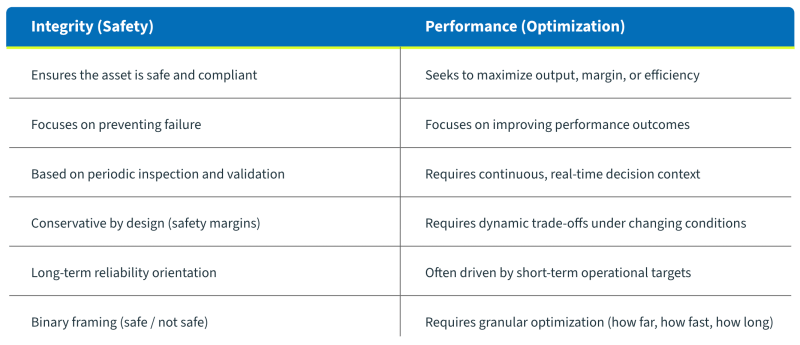
Asset integrity management answers: “Is this safe to operate?”
Performance decisions require answering: “What is the best way to operate right now?”
Those are different questions, and answering both well requires different inputs. One is about confirming safety within known boundaries. The other is about optimizing decisions at the edge of those boundaries, where the relationship between operating conditions and asset behavior is most consequential.
Integrity creates the foundation for safe operations – but it is still largely built on snapshots. One inspection shows one condition, the next inspection shows another. What is often missing is the operating history between those points: how changes in temperature, pressure, flow rate, and cycling affected the asset over time.
Industrial companies have spent decades improving process control, automation, and failure prediction. These systems provide valuable visibility into how the plant is running. But they do not fully explain how the asset itself is responding under those operating conditions. The structural behavior of equipment during live operations remains less visible, even as decisions about throughput, run length, and flexibility increasingly depend on it.
This gap is increasingly being discussed in the context of industrial AI and digital twins, where different systems provide different layers of visibility into operations. As explored in more detail in Why Industrial AI needs Structural Intelligence, not all digital approaches address what is happening inside the asset itself during operation.
How does asset integrity management connect to performance decisions in oil and gas?
In high-intensity oil and gas operations, integrity programs and performance objectives increasingly need to speak to each other. Integrity confirms that the asset is within safe limits. Performance asks what more is possible within – and just beyond – those limits.
Today, these conversations often happen sequentially rather than simultaneously. Integrity provides a periodic view; performance operates in real time. Connecting the two means making structural asset behavior part of the operating picture, not just the inspection record.
That connection is where some of the most significant value in oil and gas operations is beginning to emerge. Asset integrity management remains the essential foundation. What is developing alongside it is a capability to translate structural behavior into operating decisions – continuously, at site scale, and with the precision that high-stakes decisions require.
Asset integrity management was designed to protect assets. The next step is using that same understanding of asset behavior to guide how they perform.
The question operators are beginning to ask
This is where the tension becomes operational. On one side, integrity programs continue to validate safety based on periodic evidence and conservative assumptions. On the other, business realities demand higher throughput, tighter margins, and more responsive operations.
The oil and gas industry has become highly effective at managing known risks and optimizing processes within established boundaries. The question now gaining traction is more ambitious: not just whether assets are safe, but how well their true operating potential is understood.
Asset integrity management remains essential. It protects the asset.
But in high-intensity operations, protection alone is no longer sufficient to guide how assets should be operated.
Oz shapes the category of AI for Structural Integrity and works with industry leaders to scale adoption across complex industrial environments. He will be available for strategic conversations on predictive performance, category leadership, and how SPM accelerates industrial AI programs.