
AI for Structural Integrity (AI4SI) is a WEF-recognised technology category connecting real-time operating data to structural response. Learn what it is and why it emerged.


A new technology category has taken shape in industrial operations. AI for Structural Integrity (AI4SI) is the application of physics-based AI to structural assets, connecting real-time operating conditions to structural response continuously, so operators know how the steel is actually behaving, not just how the process is performing. It addresses a gap that APM and AIM programs were not designed to close: continuous, physics-grounded visibility into how critical assets respond structurally to how they are being operated.
AI for Structural Integrity is emerging as its own category in the Fourth Industrial Revolution and the World Economic Forum has now shown what it’s worth. When Shell’s Pearl GTL earned the WEF’s Global Lighthouse designation, AI4SI was singled out from the 45+ technologies on site, credited with +6 years of critical asset life and a 64% cut in annualized CAPEX.
This post defines what the category is, which type of software is in the AI4SI category, what falls outside it, and where it sits within the broader technology hierarchy.
Why new technology categories emerge in industrial operations
Technology categories do not form because vendors decide to create them. They form because a problem persists – one that existing tools have been asked to solve and consistently cannot.
In industrial operations, that pattern is familiar. When rotating equipment reliability became a persistent cost driver in the 1990s, APM formed around it. When regulatory risk from structural degradation demanded a systematic response, AIM became the discipline. Each category emerged to close a specific, costly gap that the tools preceding it had reached their limits on.
AI4SI follows the same logic. It did not emerge from a marketing brief. It emerged because operators running high-intensity assets – refineries, LNG terminals, offshore platforms, fertilizer plants – were making operating and capital decisions without the one input those decisions most depend on: a continuous, physics-grounded understanding of how the steel was actually responding.
The industry is spending heavily just to stand still. According to the IEA, nearly 90% of annual upstream oil and gas investment since 2019 has gone to maintaining output at existing fields – not building new capacity, not meeting demand growth. Less than one dollar in ten is moving the industry forward.
Energy security concerns have pushed operators to maximise output from infrastructure that was never designed for this intensity of use, and in some cases, from assets that have not seen meaningful capital investment in over a decade.
That gap has a name now. And it has a category built to close it.
The term “industrial AI” itself is being used well beyond that gap, though, and rarely to mean the same thing twice. See how the term is being defined across the sector before we get specific about what AI4SI actually is.
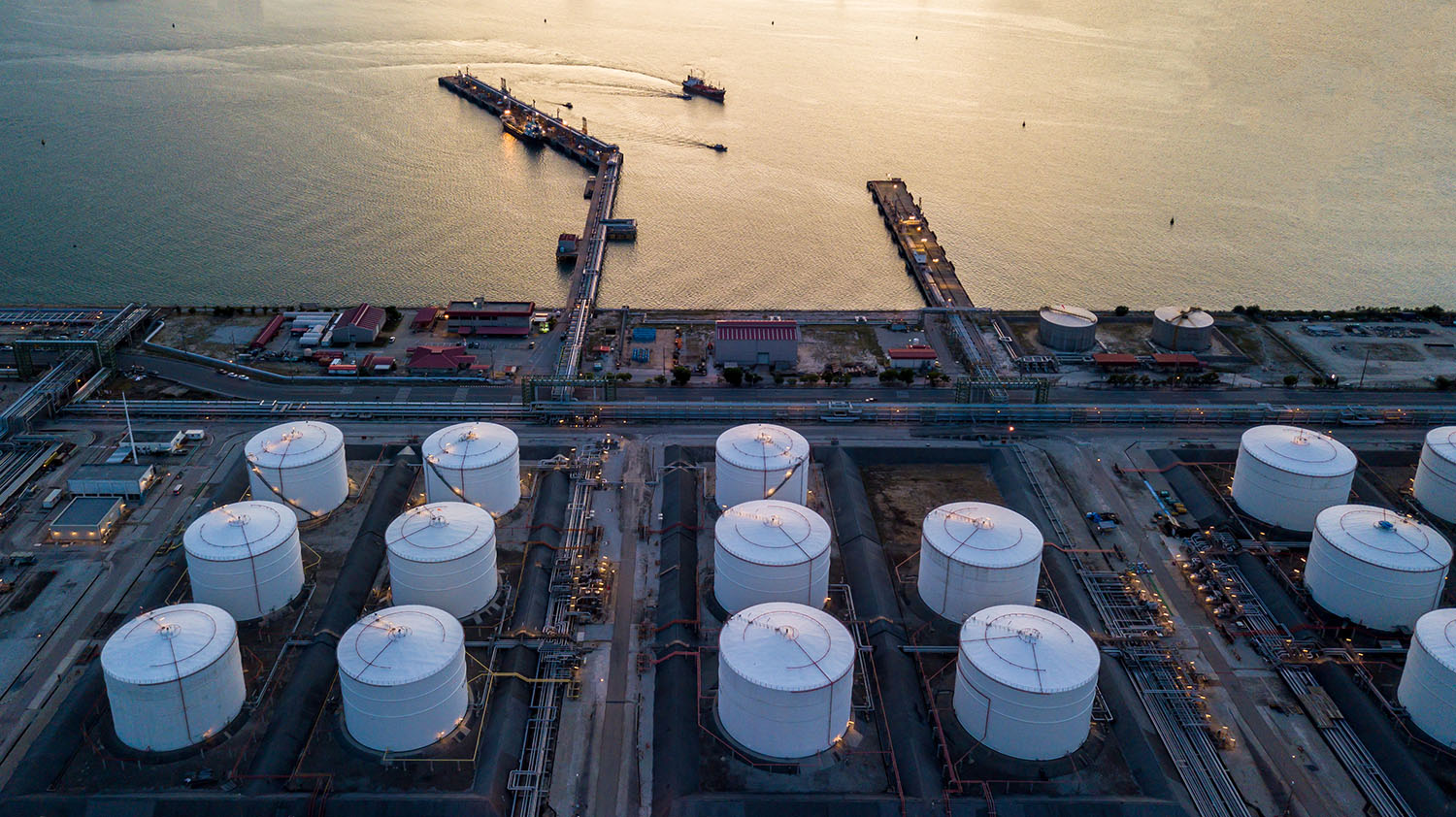
The structural blind spot – what existing programs cannot see
Operators have strong process visibility. Temperature, pressure, flow rates, operating cycles – all of it captured, logged, and watched in near real time. That visibility is real and valuable.
What it does not show is how those process conditions are affecting the asset itself.
The stress accumulates in a reactor wall under a high-temperature, high-pressure cycle. Fatigue progressing through thousands of coker drum thermal swings. Creep developing in a furnace tube running at sustained elevated temperature. These mechanisms develop internally, over time – in the space between inspection intervals, invisible to the monitoring and inspection programs designed around process and degradation data.
APM was built to answer: When will something fail? AIM was built to answer: Is this asset safe to operate? Neither was designed to answer the question that shapes the performance ceiling: How is this asset responding, structurally, to how we are running it right now?
That question cannot be answered from a maintenance schedule, an inspection record, or a process dashboard. It requires a different capability, one that connects operating conditions to structural response continuously, grounded in engineering physics rather than historical failure patterns. That is the gap AI4SI was built to close.
A pattern we see in practice: Most operators today run three types of digital twins – 3D twins for visualisation, process twins for throughput optimization, and control twins for automation. Each improves operational performance. None of them directly answers the question that matters most for structural assets: what is actually happening inside the steel while the asset operates? A refinery unit can run for years before an inspection reveals accumulated damage. By then, engineers can see what happened, but not which operating conditions caused it. That is the gap continuous structural visibility closes.
What is AI for structural integrity (AI4SI)?
AI for Structural Integrity (AI4SI) is the technology category that applies physics-based AI continuously to structural assets, connecting process conditions to structural response in real time, at full-asset scale, grounded in engineering standards such as API and ASME.
It is not a monitoring tool, a predictive maintenance system, or a process optimisation layer. It is a structural visibility layer – one that tells operators how stress is accumulating, how fatigue is progressing, and where an asset stands relative to its true structural limits, between inspections, not only at them.
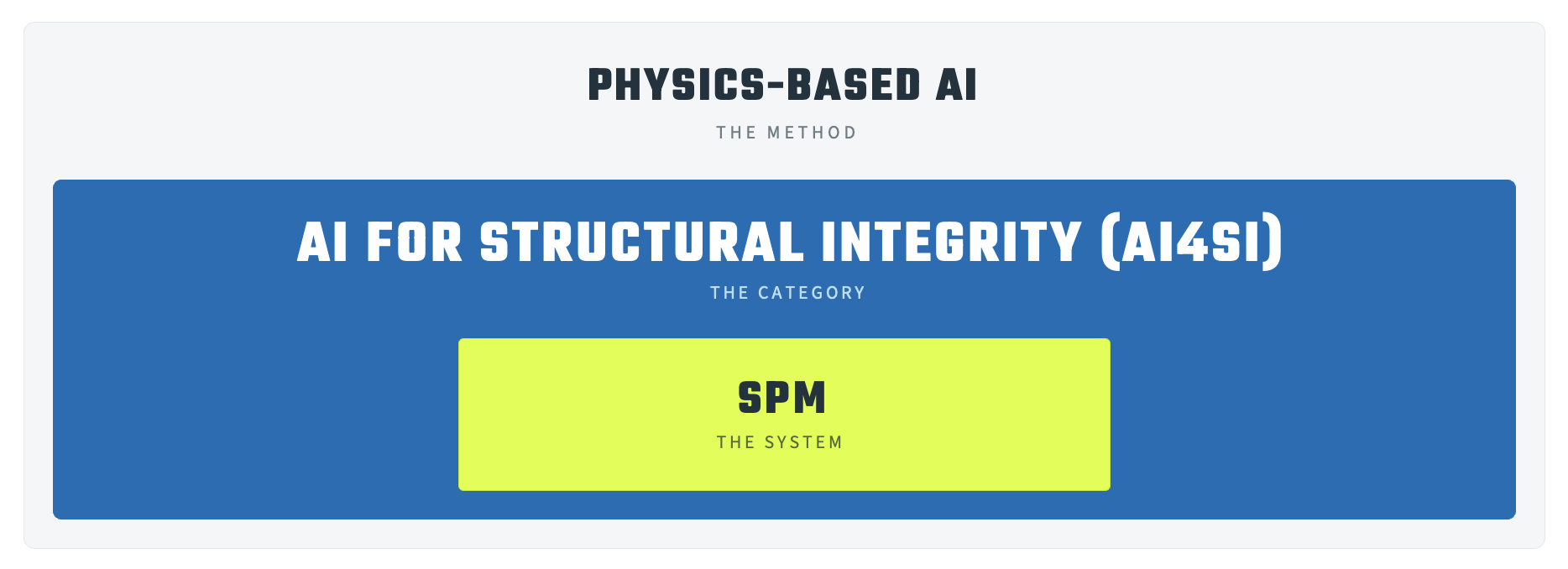
Three concepts sit in a fixed hierarchy beneath this category:
Physics-based AI is the method. It grounds artificial intelligence in the governing equations of structural mechanics, not in statistical patterns drawn from historical asset data alone, such as process and inspection history.
AI for Structural Integrity (AI4SI) is the category. It applies to software that continuously calculates the structural response of critical equipment from real-time operating data, so operators can safely push throughput and extend asset life. It’s the structural counterpart to Asset Performance Management (APM), which Verdantix defines as software that monitors operational data to predict failures and coordinate with maintenance systems to optimize reliability and manage asset risk.
Structural Performance Management (SPM) is the leading system within the category. It is how Akselos operationalizes AI for Structural Integrity, building on the capability the World Economic Forum recognized at a Lighthouse site, continuously and site-wide.
The method enables the category. The category is what the system delivers. SPM is how AI4SI is operationalised.
What do systems in AI4SI look like?
A system in AI4SI applies physics-based AI continuously to critical equipment, delivers real-time structural visibility site-wide, and assesses its results against recognized engineering standards such as API, ASME, or equivalent.
Four criteria define membership in the category:
Physics-based grounding. Statistical inference is great but it must be bound within the rules of physics, especially for critical equipment that is usually pushed hard.
Continuous, not periodic. The system must produce structural visibility between inspections – not snapshot assessments at fixed intervals. Periodic structural assessment are key checkpoints and valuable engineering practices, but the defining characteristic of AI4SI is that structural state is known continuously, at the speed of operations.
Completeness at fidelity. AI4SI leaves no structural blind spots. It models the complete asset across its full operating range, covering a whole FPSO, an ORV across every pressure and temperature it runs, a refinery unit or site-wide, not a single point at a single condition.
The engineering term is completeness at fidelity, and it’s the bar RB-FEA, Akselos patented method, uniquely clears: high-fidelity analysis used to force a choice between depth and coverage. RB-FEA runs it complete and continuous, so the picture is always whole, and always current.
Engineering standard compliance. Outputs must be defensible to engineers, regulators, and class societies under recognised standards. A system whose structural conclusions cannot be validated against API 579, ASME VIII, or equivalent does not meet the bar.
What is not within AI4SI?
An AI for Structural Integrity (AI4SI) system is not a structural monitoring tool, an RBI program, or a one-off FEA study. While AI4SI utilizes data from these systems to calculate how critical equipment behaves under real operating conditions, it focuses on continuous structural analysis powered by physics-based AI and grounded in engineering standards (API, ASME), rather than flagging anomalies, scheduling inspections, or running periodic studies.

Why did AI for Structural Integrity become viable now?
AI4SI becoming viable required three things to converge: physics-based AI reaching engineering-grade fidelity, compute cost falling far enough to make continuous full-asset structural analysis practical, and real-time operating data becoming standard infrastructure at most mature industrial facilities.
The structural blind spot is not new. Engineers have understood the gap between process visibility and structural response for decades. What changed is that each of the three prerequisites (method, compute, data) reached the threshold that made a continuous, site-wide structural visibility layer feasible to build and operate.
Physics-based AI matured. Techniques for grounding AI in the governing equations of structural mechanics reached a level of fidelity and stability that made continuous structural analysis defensible to engineers, not just statistically probable. The outputs could be presented to an integrity team, a regulator, or a class society and withstand scrutiny.
Compute cost fell. High-fidelity structural analysis at full-asset scale had historically required prohibitive resources. A full FEA run on a complex asset could take days, making continuous structural visibility operationally impossible. Akselos’s patented RB-FEA solver changed that. Running structural simulation 1,000 times faster than conventional FEA at equivalent accuracy, RB-FEA made continuous, full-asset structural analysis practical for the first time: not as a periodic engineering exercise, but as a live operational input.
Real-time operating data became available. Process historians, integrity monitoring systems, and real-time sensor infrastructure are now standard in most mature industrial facilities. The data needed to connect operating decisions to structural response was already being collected. AI4SI provides the layer that integrates and makes use of it.
No single one of these changes would have been sufficient. The convergence of all three is what created the category.

Third-party validation: what WEF recognition means for operators
At Pearl GTL, the application of AI for Structural Integrity was recognized by the World Economic Forum as part of its Global Lighthouse Network – the WEF’s designation for industrial facilities demonstrating Fourth Industrial Revolution technologies at full scale.
That classification is assessed against criteria of full-scale industrial deployment, measurable outcomes, and genuine transformation of how industrial work is organised. It is not a vendor designation or an industry association award. It is an independent assessment by an institution with no product to sell, conducted against the same framework applied to the most consequential technology deployments in global industry.
For operators evaluating AI4SI, WEF Lighthouse recognition carries a specific implication: the category has been recognised as fundamental for digital transformation and Fourth Industrial Revolution implementation. The question is no longer whether the category is real. The question is where and how to deploy it.
Explore more: How Shell Applies Structural Twins — From FPSOs to Lighthouse Sites
What the category is beginning to show in practice
Early deployments of AI4SI are producing outcomes at facilities where the structural blind spot was actively constraining operating decisions.
At Pearl GTL – a WEF Global Lighthouse facility operating one of the world’s largest gas-to-liquids plants in Qatar – connecting structural response to operational and capital decisions contributed to +6 years of critical equipment life and a 64% reduction in annualised CAPEX.
The mechanism is consistent across deployments: when structural behavior is visible continuously, the question changes. Conservative assumptions give way to evidence. Operating envelopes set against elapsed time and worst-case scenarios can be reconsidered against actual structural condition.
That shift does not require new assets. It requires a new level of insight from the data you already have.
The question the category raises
What it raises, for operators, is a question about operationalization. The category establishes what is now technically possible: continuous, physics-grounded structural visibility, site-wide, connected to the operating decisions made in the control room. The gap between that capability existing and an industrial site running structural decisions through it continuously requires one more layer.
That layer is not another monitoring tool. It is a management system – one that takes the structural insight AI4SI produces and makes it actionable across operations, integrity, and capital allocation simultaneously.
Physics-based AI is the method. AI4SI is the category. The system that operationalises AI4SI across an industrial site is where the next post in this series begins.
Read next: Introducing Structural Performance Management: The Missing Operating Layer
Key takeaways
- AI for structural integrity (AI4SI) is the technology category that applies physics-based AI continuously to structural assets, connecting real-time operating conditions to structural response, at site-wide scale, grounded in engineering standards such as API and ASME.
- A system qualifies as AI4SI only if it meets four criteria: physics-based grounding, continuous not periodic visibility, site-wide not asset-level scope, and outputs defensible under recognised engineering standards.
- New technology categories form when a persistent, costly problem exceeds the design limits of existing tools. AI4SI emerged because neither APM nor AIM was built to connect operating decisions to structural response continuously.
- The World Economic Forum has recognised AI4SI as a Fourth Industrial Revolution technology – independent confirmation that the category is real, assessed against criteria of full-scale industrial deployment and measurable outcomes.
- At Pearl GTL, applying this category of visibility contributed to +6 years of critical equipment life and a 64% reduction in annualised CAPEX.
- Physics-based AI is the method. AI4SI is the category. Structural Performance Management (SPM) is how AI4SI is operationalised across an industrial site.
Thomas leads the company from inception to becoming a trusted partner for operators managing some of the world’s most complex assets. His work sits at the intersection of the Fourth Industrial Revolution, applying the right tools to the right problems, and driving disruptive innovation that strengthens real-world infrastructure.