
SPM for Cokers calculates coke drum remaining life after every cycle, assessing fatigue, bulging and crack growth on one digital twin of the drum.

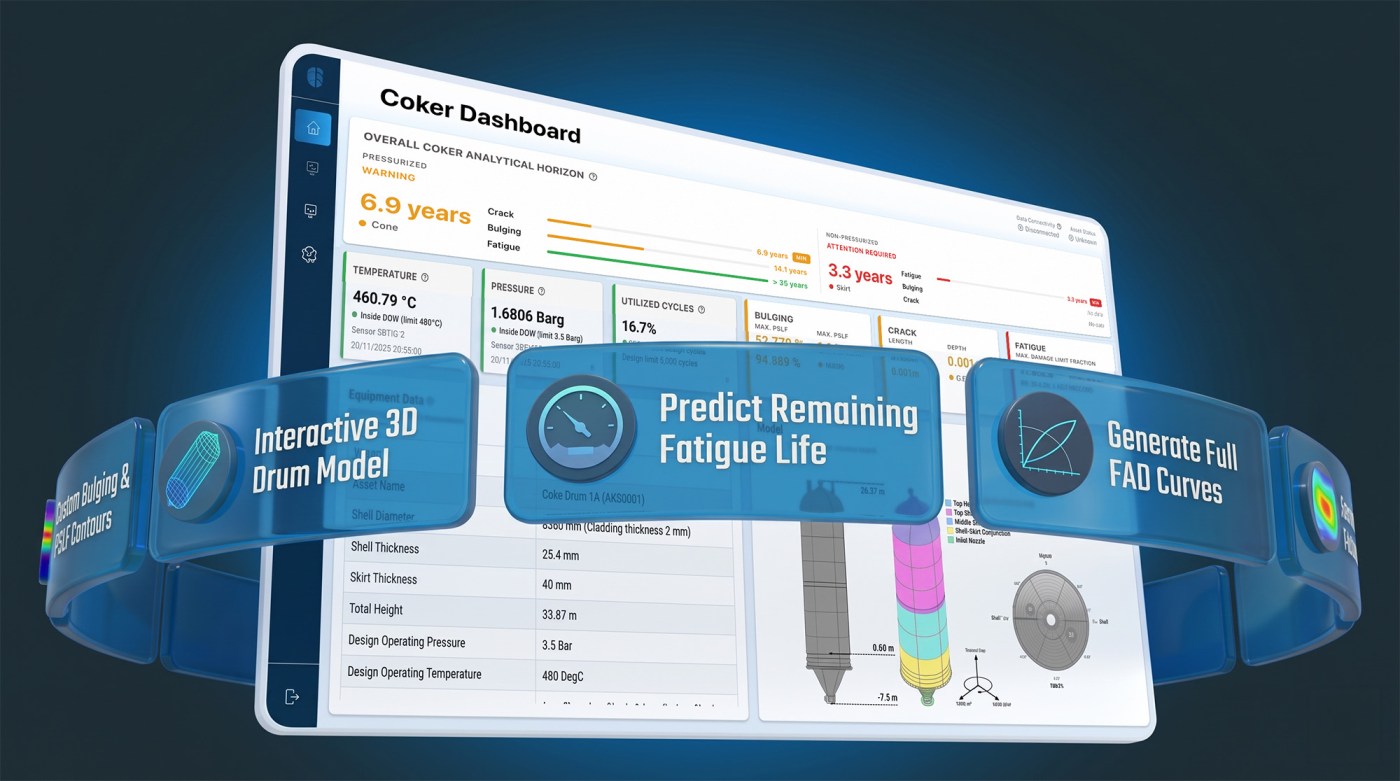
Akselos has launched SPM for Cokers, which assesses fatigue, bulging and crack growth on the same digital twin of a coke drum after every cycle, and reports remaining life separately for each mechanism.
All three now run together, after every cycle, so drum life is managed cycle by cycle and each assessment is current to the last cycle run.
Why coke drum damage concentrates in a few cycles
A delayed coker converts low-value vacuum residue into lighter, higher-value products by putting its drums through extreme thermal and mechanical stress. That stress accumulates unevenly. Quench water channels through the porous coke bed, producing local hot and cold spots, and a bad channeling event puts far more strain into the shell than a clean cycle does. A small share of cycles drives most of the damage.
At Pan American Energy, 2.2% of coker cycles caused 83% of the drum damage.
The industry has understood the mechanism for decades. SPM for Cokers adds attribution: which of last month’s cycles drove damage, and by how much. The margin carried between inspections becomes a measured quantity operations can run against.

How SPM for Cokers calculates remaining life each cycle
SPM for Cokers runs on a high-fidelity, fully parametric digital twin for structural performance of the coke drum. It carries the complete physics of the steel. After each cycle, that cycle’s operating data, such as temperatures, pressures and quench timing, is fed into the same model, so each assessment reflects how the drum was actually run.
To establish the drum’s current condition, SPM first works through decades of its cycle history: tens of thousands of solves on a five-million-degree-of-freedom model. From that baseline, it runs one assessment per cycle at the same accuracy, covering fatigue per API 579-1 Part 14 Level 2, bulging and crack growth. The same solve, run often enough to be operationally useful.
Remaining life is reported separately for each mechanism. A drum can be fatigue-limited and bulge-tolerant, or the reverse. The intervention differs in each case, and refiners can see which mechanism limits a drum’s life, and which cycles drive it, before deciding how to run the next one.
What’s in this release of SPM for Cokers
SPM for Cokers brings the three damage assessments and the Akselos Portal together on one digital twin of the drum.
- Akselos Portal: a web interface that shows simulation and assessment results alongside live asset data on an interactive 3D model of the drum.
- Fatigue assessment: tracks fatigue accumulation cycle over cycle and predicts remaining fatigue life, with results split between pressurized and non-pressurized regions.
- Bulging assessment: recalculates the Plastic Strain Limit Fraction (PSLF) after every operating cycle and projects future bulging life. Results are split between the shell and cone regions, and users can set their own bulging and PSLF plot contours.
- Crack assessment: calculates critical crack size thresholds, models crack growth, and generates full Failure Assessment Diagram (FAD) curves.
How operations and integrity teams use per-cycle remaining life

Operations and integrity teams look at the same steel and ask two different questions of it. Operations asks how hard the drum can be run this cycle, tuning quench to p
rotect the drum while holding production speed. Integrity asks how much life the drum has left, working from periodic inspection, which by design carries a margin for everything that could happen between scans. One digital twin, updated every cycle, gives both teams the same picture, and the margin integrity that has carried becomes usable life.
A pattern we see in practice: when operations and integrity see cycle-level damage attribution together for the first time, the conversation moves quickly to which cycles were worth it. Teams find that a handful of aggressive quench events, run to protect a production target, consumed years of drum life. They also find cycles they had assumed were expensive that turned out to be almost free.
That shows up as deferred capital. A drum reaching end of life is a capital event with a long lead time and a fixed date. Calculate remaining life every cycle, attribute it to the cycles that consumed it, and that date is set by measurement. Akselos modeling estimates that running a drum’s 100 highest-fatigue cycles differently can safely add around 8 years of drum life, worth roughly $17 million in deferred capital on a pair of coke drums.
The same logic extends past the drum. Hydrotreater reactors, SMR catalyst tubes and outlet pigtails each have a structural limit that sets a capital date, and each can be calculated the same way.
Key takeaways
- At Pan American Energy, 2.2% of coker cycles caused 83% of the drum damage.
- SPM for Cokers assesses fatigue, bulging and crack growth on one digital twin of the drum, once per cycle, with remaining life reported per mechanism.
- Each cycle’s real operating data (temperatures, pressures, quench timing) feeds a fully parametric, high-fidelity model, which is what makes per-cycle full-fidelity assessment practical.
- Results can be broken down by drum region: pressurized and non-pressurized zones for fatigue, shell and cone for bulging.
- Operations and integrity working from one cycle-updated model turns inspection margin into usable drum life.
- Running a drum’s 100 highest-fatigue cycles differently can add around 8 years of life, roughly $17 million in deferred capital on a pair of drums.
Attila works with offshore operators and engineering teams to turn structural insight into practical asset decisions. He focuses on helping customers improve integrity strategy, remaining life assessment, and operational confidence across complex O&G assets.