
EP. 04
The Centaur Model
Why predicting every failure is a utopia, and why the best results come from people and technology together.
Javier Mascheroni
Physical Asset Management
~32 minutes
Video first
About this episode
Can you anticipate every failure? Javier Mascheroni calls it a utopia: everything available all the time, at low cost, with no risk of failure. Some failures are random, and no maintenance activity makes sense for them. Others can be caught, but catching them isn’t worth the cost. His example is the light bulb. You could measure how much life the filament has left, but when it fails, you change it and move on.
Where the stakes are high, technology earns its place. Javier describes four-legged robots carrying thermal cameras and leak sensors onto tanks where you’d keep people away, and a machine learning system that spotted a refinery turbine problem six months to a year out, early enough to plan the repair into a scheduled shutdown. The operator still stays in the loop with the final say, what Kasparov called the centaur model.
The rest of the conversation is about people. Technology projects imposed from corporate, without the end users who’ll make decisions with them, are “dead before they start.” And engineers still struggle to put their proposals in business terms. Bring senior management a lubrication problem and they won’t get it, because it’s really a communication problem.
Episode structure
The light bulb rule | 7 min
What drives Javier to share what works, and how a simple light bulb shows when to run to failure and when early detection earns its cost.
The centaur model | 11 min
How robots and AI extend the operator’s senses, why people keep the final say, and how involving users early turns new technology into a daily habit.
The language of business | 5 min
Why engineers at every career stage struggle to frame technical work as an investment case built on risk, cost, and benefit.
Ahead of the failure | 8 min
A refinery turbine flagged six months to a year ahead, a model that recognized a pattern it had seen before, and why short-termism wins without leadership sponsorship.
Full transcript: Asset Life EP.04 with Javier Mascheroni
[00:28] Oz Rodriguez: Welcome to the fourth episode of Asset Life. I’m Oz, and today I have the pleasure of being joined by Javier Mascheroni, a physical asset management professional with a long career in Argentine industry. Welcome, Javier. How are you?
[00:43] Javier Mascheroni: Thank you very much, and thank you for the invitation. It’s a pleasure.
[00:47] Oz: Okay, let’s get straight to it.
[00:49] Javier: Let’s go.
[00:50] Oz: You teach at the university, where you’ve taught a postgraduate diploma in asset management. You’ve worked as an executive manager of asset management, and you’re actively involved in the Robotics Committee of the Argentine Center of Engineers. I don’t know when you rest, but that’s who you are. I feel that behind all of this there’s a search, in industry, in academia, with your peers. What is that search?
[01:17] Javier: Across all of these settings and professional activities, there’s a pattern that repeats itself. All my colleagues, or my students when I’m in academic mode, run into the same problems. The years go by, the generations change, undergraduate curricula change, and the speed of organizations changes. But when you look at the problems different asset managers live with, they’re the same. You go to a class, and the issues raised are similar to the ones you find inside organizations.
On a personal level, having spent quite a few years in this field, I feel an obligation to work on communicating, spreading the word, and helping to solve that. Being in different professional settings lets things circulate: sharing at conferences, at outreach events, in academia, and collaborating with organizations. When it’s not professional work, it often comes out of exchanges between peers. What drives me is helping make sure that what worked in one organization can help someone who is dealing with the same problem. It’s very rewarding when you have the chance to help and collaborate in the community you move in. The chance to give back and to build isn’t valued enough. I think that’s the driver that cuts across everything I do.
[03:20] Oz: I think it also has a lot to do with companies. Sometimes they guard information, methods and statistics very closely. Obviously, a lot of the time it’s for competitive reasons, but I think you can often reach the point you mention, of sharing what you’ve learned so the same thing doesn’t happen to someone else.
[03:47] Javier: No doubt.
[03:48] Oz: On that same point, looking at your career, you’ve spent your whole career understanding how things break before they break. Can you really anticipate everything, or is it a promise that never really comes true?
[04:09] Javier: It’s a utopia that all of us who make a living from this want, right? It’s the perfect dream: everything available all the time, at low cost, with no risk of failure, and we just focus on optimizing production. In real life, the more complex the organizations and the types of assets are, the more varied the failures.
There are lots of failures that can be captured with the right maintenance strategy, going after the specific damage mechanism with the right tool. There are hidden failures, where failure-finding techniques are used. Basically, that means putting demand on the equipment or systems to find the problem and bring it to light. There’s equipment with infant mortality, or with failure mechanisms associated with degradation, where over time it fails more and more. Those can be captured if you have the right technique, inspection, or fixed-interval maintenance activity.
The ideal is condition assessment: monitoring what’s happening in the assets through some direct or indirect variable, so you can detect problems very early and plan when to fix them. The thing is, from the original study by Nowlan and Heap in the 70s that founded RCM onward, nobody has found that all failures can be solved the same way. Lots of failures are random, and for a random failure there’s no maintenance activity that makes sense. For those, you have to know they’re going to happen and be ready to fix them quickly.
Then there’s the other pattern: sometimes you can detect, capture and identify a failure, but it’s uneconomical. That’s where you weigh the effort of capturing the problem early against the impact it has. There’s a financial and impact trade-off that has to make sense.
An example I often use in class: suppose there were a technique to assess how much life the filament of an incandescent light bulb has left. Great. You could do condition monitoring and determine a bulb’s remaining life. Does that make any economic sense? No. If it fails, you change the bulb, and that’s it. It’s run to failure, purely corrective, whether in your car, at home or in industry. There’s no logic in replacing bulbs preventively because one might fail. The right strategy for that type of device is to run it to failure, change it when it fails, and that’s fine.
But where the criticality or impact of failure is high, for safety, the environment, operations, the community, or whatever we value in our organizations, then any technique that lets us detect the failure early, from the whole range of maintenance management options out there, is welcome. So the answer is no, there’s no way to capture everything. And even if there were, it wouldn’t necessarily be the best idea.
[07:39] Oz: Right. You don’t need to implement a digital twin on a bolt. It isn’t viable, and you’d have to check millions of bolts, which makes no sense. So that balance is very important. But you mentioned something else that’s important. I feel technology also helps us get people out of hazardous areas. The fewer people who go into hazardous areas, the better for everyone. You’ve replaced human eyes with drones or sensors, for example, and you’re very open to technology.
But I want to ask about that trade-off. There’s the operator who has walked that refinery for many years and has that intrinsic knowledge of the plant. Is that lost when it’s no longer a person walking the plant?
[08:34] Javier: I think it’s lost if the implementation and the technology process are poorly designed. In general, the best results we’re seeing come from the union of technology and people. Many people debate whether the human has to be in the loop, part of the decision-making process. Personally, from experience built up over years of applied technology work, that’s the best approach.
The best of both worlds is getting access to technology and sensors that let you reach places that are hard or uneconomical to reach, or where it’s complicated or impossible to measure. Technology gets you there. But then you need to rely on the operator or technician who puts the data in context, who interprets whether the information is actionable, whether a decision really needs to be made, or whether it’s a measurement error or an outlier with no value and no impact. I think that’s where the added value is.
Take what you said about operators in inaccessible places. In Argentina today, you can get four-legged walking robots and add sensors to them. They can carry thermal cameras, ultrasonic sensors to detect leaks and losses, and radar to detect where things are. They can climb on top of tanks, where you’d normally keep people away for safety reasons. Now there’s AI on top to interpret the images and capture the data. That’s perfect.
Does it replace my operator? Not in my view. What it does is give greater capability to the operator’s natural senses. The operator is the one who then has to analyze the alarms, alerts and messages the technology sends, because they’re the one who gives them context. They understand whether a reading makes sense, whether it’s a gauge issue or something real, because they can cross-check other variables the technology probably won’t identify.
That’s the best of both worlds. As Kasparov put it, the centaur model: both things at the same time, capturing the best of both sides. If you think only about technology, you lose context and the human element, and there are lots of things that even the most advanced AI still can’t replace. And if you stick with “I just need people, technology is going to replace me, and that’s a bad thing,” that’s also a problem. In my opinion, it’s a question of how you design the technology innovation process. It has to be clear that operators are part of the process, the human in the loop, and that they have the final say in decision-making.
What we’ve seen so far is that, contrary to what you’d imagine, technology doesn’t degrade the human role. It elevates it. Operators no longer have to go out and collect information or look at raw data. They have to interpret it, make decisions, and dig deeper to understand the root causes behind the problem. It’s harder. It elevates the analyst’s role and raises the bar. Technology is used to find correlations and things that aren’t easy to see, but the decision has to be triggered by the human.
[12:16] Oz: And that’s when you bring in all your knowledge and experience to say, “No, that’s not right.” It also connects to something very important you said that’s worth highlighting: context. The human provides the context. Take AI. Without good context, it’s useless. It won’t give you the right answer. It will hallucinate and go off in other directions. If you don’t give good context to all that information and processing power, it’s almost impossible to get results.
That makes a very good bridge to what you said at the end: it raises the operator’s profile, because now they have to analyze. The job is no longer “I have to collect this data.” You already have the data. What are you going to do with it? That means the plant’s culture changes. The culture of the engineers and operators changes from reactive to predictive. It’s not just installing sensors, adding AI or deploying drones. It’s how people think. What have you seen as the best practices for making that cultural change when there’s a technology disruption like the one we’ve been seeing?
[13:47] Javier: Wow. It’s communication, communication, communication. What we were just talking about has to be clear from the very start. If a person believes a technology is going to make their job obsolete, it’s going to be hard for them to be open to cultural change. It goes against their nature, against the survival instinct that has carried us since ancient times.
Now, if you frame it the way we were just discussing, and not just as a speech, but by actually managing it in a way that changes how things are done, training people to use those tools better and helping them understand how the processes change, it works. At the end of the day, culture is what we do repeatedly. It’s based on how we define processes, what we talk about in meetings, and which topics get reviewed. So if you show through real actions that the processes are changing, that the way of working is different, and that it isn’t working against people but elevating their work, it’s hard for that to backfire.
In that context, if you involve the future end users early in these innovation projects, support them in designing how they’ll interact with the technology, and let them rewrite the processes they’ll be living with, then by the end you don’t have someone resisting the change. You have a staunch advocate of the model, because they basically built and designed it.
When I see technology innovation processes that come down from corporate or centralized parts of the organization, without the active participation of the end users who will make decisions with the technology, those processes are dead before they start. It’s a change process where the person who has to lead and drive the change, the user, is left out. All those imposition models fail. Industrial organizations are often not democracies. Things are imposed through the organization, but that doesn’t mean they’re really adopted or sustainable over time.
To wrap up the question: what I’ve seen work well is well-designed processes that account for the cultural changes that will happen, with the main person who will make decisions with the technology involved in the pilot project. And if you can involve them one step earlier, from the conceptualization of the initiative while they’re still discussing the need, that’s the right path. You walk the whole process step by step: identifying the need, doing the inception, running a demo or pilot project, and scaling it. Obviously you have to move as fast as possible so you don’t lose momentum with the technology, but that also builds culture around the technology.
[17:12] Oz: Right.
[17:13] Javier: It ends up being part of everyday work. When we implemented predictive AI with machine learning, it went through that whole path. The process started more than eight years ago, and at some point it became routine for the reliability engineers. The first thing they looked at in the morning was the alerts they had received: whether any machine was warning of a change in behavior pattern. It was part of the culture to open the email, review it, and immediately start analyzing with the technicians whether it was real or a data error, whether to act or make a decision, and whether the end customer needed to be told there was a problem. That is cultural. Today, that type of process is built into what they look at every day as part of their daily work.
[18:11] Oz: That’s incredible. I feel that, especially in the adoption process, managers and the corporate side have to help with communication, so it’s not a small project in a corner of the company but something visible from the highest levels of the hierarchy. That visibility helps the project move forward. But you’re right that the inception of the culture, and of adopting the technology, has to do with the user, the person who needs that data, visualization or report every day to do their job better.
It’s interesting, because the transition from university to internships to the job is a journey of its own, one we all go through. You teach and you’re involved in academia, and I think it’s one of your passions. What do you see in young engineers today that isn’t yet being taught, that you think is essential? Or do they all come out with all the information they need?
[19:28] Javier: Let’s see. I think it’s something we need to work on with young people, but I say it based on seeing the current generations already working. It’s very hard for technical people, engineers trained in the hard sciences in general, to translate problems, or the proposed solutions to those problems, into business language.
As we discussed earlier about maintenance strategies, everything is a negotiation between benefits, costs, performance and risks. Asset management in general is a balance between risks, costs and benefits, with risks seen as opportunities too, not only on the negative side. You have to balance all of it and put it in a single package. What I often see is that we tend to compartmentalize it. Technical engineers solve technical problems. They know how to repair equipment faster or implement a technology. When it comes to analyzing costs, there’s someone who does costs, someone who does budget evaluation, someone who evaluates internal investment projects, and then someone who makes decisions. They’re siloed. At the end of the day, what the engineer has to do is give tools to whoever makes the decisions upstream, or be able to justify the decision themselves.
What I see is that disconnect. And I don’t just mean young people. It’s also hard for the two or three generations before them to translate a proposed solution or project, whether it’s technology or any other improvement, into those terms. How much does it cost? What are the benefits? What’s the range of uncertainty? We build the cash flow from time zero in Excel, calculate the NPV and IRR, and say this project makes sense because of this. This is the organizational effort it requires in money and resources. These are the benefits, and this is what we’ll capture in reliability improvement and economic impact. Even though most universities and technical programs have a finance course, in practice it rarely looks like that. It always ends up being an attempt to count the technical benefits.
You hear it a lot: “The problem is that the people at the top don’t get it. They don’t understand us.” They don’t have to understand you technically. You have to adapt to the language of business, because it’s a business. The picture is framed backwards, and it keeps repeating. Just days ago at a conference, I heard it again: senior management doesn’t get it when we bring them a lubrication problem. It’s not a lubrication problem. It’s a problem of us not being able to communicate.
Our generation, with some gray hair already, still suffers from that. Imagine the younger ones coming up, seeing everything separately. The clash with reality hits once they’re inside organizations. So I think more emphasis is needed there. You have to keep in mind that all asset management decisions, whether in projects, maintenance, integrity or reliability, involve investing either to lower risk or to improve benefits, with a cost in between. You have to put everything in one place, evaluate it, and translate it into financial language so it can be compared with other spending or investment alternatives, whether OPEX or CAPEX.
[23:16] Oz: Yes. Ten years ago I did my master’s degree, and everything was in components. Economics is here, accounting is here, marketing is here, but that integration you’re talking about is missing. Being an engineer doesn’t mean my proposals speak for themselves. My ideas have to be framed in terms of value. What does this mean for the company? For my colleagues? For me? We’re used to doing tasks, working from a task list or a body of knowledge. That connection or correlation between things still isn’t taught systematically. You only acquire it through work, through valuable practice that teaches you that the first report you write stinks because it lacks the value. You speak the engineer’s language, and the president of the company or business unit may not understand it, because we’re focused on the technology and not on the result.
That’s very interesting. Another thing I wanted to ask you, since everything shares a common thread, the whole topic of culture: the culture that comes from university is important, and the culture of technology adoption is important. I’d like to hear a successful use case where the predictive culture we’ve talked about worked. There are times when it doesn’t, as you already explained. But I think you could write a whole book on the moments when this predictive culture mattered: something no one saw coming, where data connected the dots and you managed to find it. I’d like an example to ground what we’ve discussed today.
[25:05] Javier: I think the most successful cases I’ve seen use predictive maintenance with machine learning, using AI. What these tools allow is finding correlations across a lot of variables. We’re talking about 20, 25 or 30 variables. We can see a correlation between two variables. We can draw the line and understand it. In three dimensions it already gets difficult for us. With 20, 25 or 30 variables, it’s too complex to do by hand.
With these tools, you train them on the normal behavior of the equipment. The tool learns the combination of variables in the normal state, across several normal operating states, and then keeps monitoring. When it sees one, several or all of the variables move away from normal behavior, it raises its hand and tells you there’s a behavioral anomaly. That’s practically impossible to do without a tool like this, because the analyst won’t see that whole combination. They’ll see the outcomes: a temperature, a vibration, an excessive pressure differential. By then you’re already at a later stage. The equipment still hasn’t failed, but it’s no longer incipient.
This applies to rotating equipment: large compressors, turbines and generators with lots of temperature, pressure and vacuum variables, and speeds. They’re generally critical equipment providing critical services, at power generation companies, refineries, or anyone with a compression service, like gas pipeline compressor stations. All that equipment is heavily instrumented, so you have a lot of data, which makes this very feasible.
In the particular case of the refinery, we saw these systems detect the onset of axial displacement in a turbine. It wasn’t really a problem yet. It was going to be a problem in six months, eight months, a year, but we were already seeing it. It was detected early, and that let us plan and adjust the timing of a planned shutdown to match what the machine needed. We could organize the spare parts and line up the people needed. It wasn’t a scramble 10 days before the shutdown, or an unplanned shutdown that hit production directly.
That was one example. In another, a similar but somewhat bigger machine had an odd dynamic behavior that had already been studied in the past. So we had the history, and the system said: what happened to you back then is happening again. That’s even more serious, because you already know the consequences and the damage mechanism. The AI knows too, because you trained it with both normal and failure data. It tells you the same failure you had before is happening, and the probability of it turning into a corrective failure is this much. So you monitor how that probability progresses while you rush to get the spare parts and plan the work. I’d say this type of application is what I’ve seen make the most sense.
Also, with digital twins, you can run complex studies you normally can’t do. You can run failure studies and visualize the impact the operating variables are having on the remaining life of the assets, with complex calculations you could never do by hand. Being able to act quickly lets you project how that remaining life evolves over time and make operational decisions to manage the trade-off between how much remaining life the asset has and how hard you push it. Without current technologies, you can’t do that.
We come back to the same point. The output of these tools has to go to a qualified technical specialist who can understand it, and who also has to be elevated to understand all of it, because it’s not easy to build the models or train the teams or technologies, and even less to interpret them. And you’re working at an earlier stage of the failure.
I’m a mechanical engineer, and I went through every stage, from supervisor to technical specialist, head of specialty and installation specialist. As mechanical engineers, we look at temperatures, pressures, flow rates and vibrations. That’s fine. But when what you’re seeing is a change in an operating pattern that will lead to a failure within a year, or five or 10 years, you don’t see a temperature or a pressure. You’re seeing a change in dynamics, and you have to sit down with process engineers and operators to look at the variables that can potentially lead to those mechanical deviations. It’s harder. You have to go into thermodynamics. You have to work as a team with people from other disciplines. It’s great, it’s proactive, and you get ahead of the failure. But it’s technically harder, and people have to believe you.
[31:04] Oz: Exactly.
[31:05] Javier: The problem doesn’t exist yet. You’re explaining something that could happen if you don’t change what’s happening in the equipment today. So it competes with the urgency of day-to-day decision-making, while you’re looking at something very long term. That’s where it comes down to organizational sponsorship: having management or leadership teams who are bought into the benefits of the technology. Otherwise, if it’s just a technician competing with the immediate decisions of what’s happening today, short-termism wins.
[31:40] Oz: I think that’s an excellent summary of everything we’ve talked about today: context, and how all this access to data and tools pushes us to lift ourselves up as professionals. Not just looking at the data, the temperature, the flow or the pressure, but understanding what that behavior means and what to do with that information. That’s where context becomes super important.
Javier, this has been a very interesting conversation. Thank you for sharing so many battles and so many years of experience with us and the audience. We hope to have you back at some point. Thank you very, very much.
[32:24] Javier: Thank you for the invitation. It’s been a pleasure.
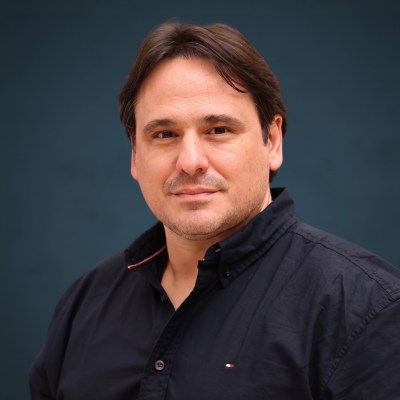
Javier Mascheroni | Guest
Physical Asset Management
Javier Mascheroni is a mechanical engineer with a long career in physical asset management in Argentine industry. He has worked through every stage of the field, from supervisor to executive manager of asset management, and was part of implementing machine learning-based predictive maintenance more than eight years ago. He teaches at university, including a postgraduate diploma in asset management, and is an active member of the Robotics Committee of the Argentine Center of Engineers.
NEWSLETTER
PREVIOUS EPISODE
EP. 03
The Hitch in the Giddy Up
An Air Force satellite specialist, almost thirty years into a career at Koch, now watching AI finally crack a data problem the industry couldn’t solve any other way.
Guest: Tim Shanfelt | Operations Enablement Director, Koch Ag and Energy Solutions